 English





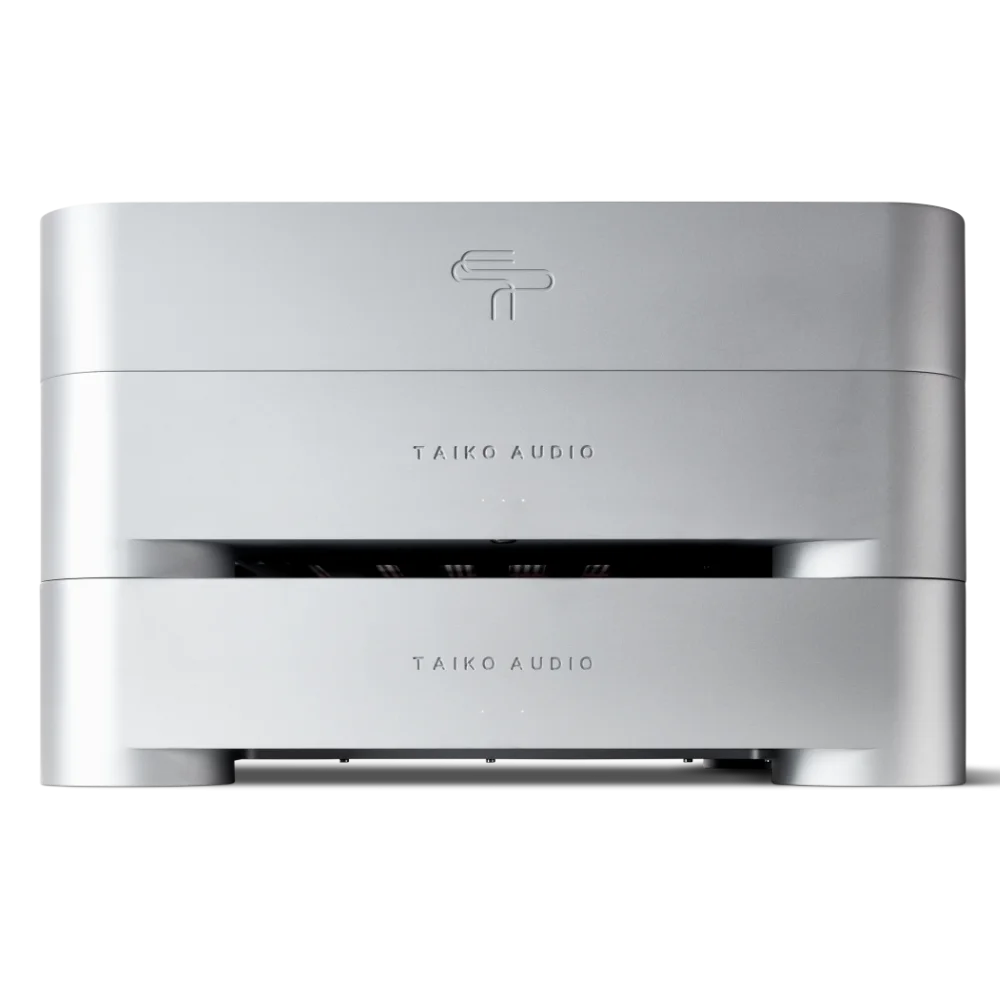
Taiko Audio OLYMPUS SERVER XDMI + OLYMPUS I/O XDMI
26.06.2025
- The authorWojciech Pacuła
- SourceHigh Fidelity
Taiko Audio was founded by Emile Bloks, who built his first loudspeaker at the age of twelve. In 2008 he designed and manufactured his first audio products. Today the company's main offering is an audio file server/transport called the Olympus. It is one of the most advanced and most expensive products of its kind in the world.
Soviet cosmonauts never landed on the Moon. They planned to, but it did not work out. The only people to walk on the surface of the Silver Globe were Americans. Even so, my childhood was spent in the cult of cosmonauts, those "aviators of the void", in memories of the flight of the first and so far only Pole in space, Mirosław Hermaszewski (Soyuz 30 mission, 1978), and – finally – in the cult of toys connected with the space through which the Earth hurtles like a mighty spaceship.
Poland was then an involuntary part of the Eastern Bloc, so the horizon of my imagination was formed on the one hand by the language used by the official "organs" – radio, television and the press – and on the other by the language I heard at home. The former taught me that a "cosmonaut" was "our" envoy to space and that he was the most important – implicitly, the only one. The latter whispered an alternative vision in which the Americans had their own envoys, whom they called "astronauts". Its confirmation was a photograph from one of the Apollo missions, handed out by the American consulate in Kraków and hidden by my parents at the bottom of a wardrobe. Because it was hidden, I looked at it often.
The imagination I built on this foundation received a remarkable complement in the form of a tangible object. When I opened my eyes one morning, it turned out that my father had come back from a work contract in the GDR (East Germany) and brought me a present – a Lunokhod (Rus. Луноход). Of the four versions of this lunar exploration vehicle built in the USSR, only two reached the Moon. I try to remember what it looked like, but I cannot. It had rubber tracks, so it was not a toy from the Soviet Union. What I do remember perfectly is the excitement and emotion that almost fried my brain at the time.
Back then we did not yet know that astronauts and cosmonauts would later be joined by representatives of other nations with ambitions to explore space. The most important of them turned out to be those of the People's Republic of China, called taikonauts. Their rover also landed on the Moon – on the far side of our satellite, no less (it was the Yutu rover, Chin. 玉兔, "Jade Rabbit"). Which reminds me of a joke about the Soviets and the rockets they fired at the Moon. But that is a subject for another time…
All the more so because the name Taiko Audio has a different origin. For me it will always be associated with space, ever since I saw the company's products in the Japanese quarterly "Stereo Sound", but for the rest of the world "Taiko" will rather mean "drum" (Jap. 太鼓) – a Japanese percussion instrument. It set the rhythm for performances such as nō, kyōgen and kabuki and had a significant influence on their development. The drum, then, is what sets the rhythm, creates a pattern onto which further layers can be added.
Taiko Audio
Giving a company a foreign-language name is perfectly natural. In Poland it is almost without exception English: Orange, 11 Bit Studios, Arctic Paper. Looking at the names of audio companies in our cultural sphere, one could say others do the same: Avantgarde Acoustics, Circle Labs, Gold Note or Pro-Ject. Every now and then you come across names referring to Latin – Audio-Technica and Ferrum Audio, for instance. This is natural and fully legitimised by experience: such companies draw on the lingua franca of their time.
Many Asian companies, Japanese ones for example, have adopted English names. Cases going the other way, however, are extremely rare. Let us mention Koda, whose logo consists of Japanese characters, or Kiseki, whose name means "miracle" in Japanese. Taiko Audio therefore stands out from the start with a name that sends us into space.
The company was founded by Dutch IT engineer Emile Bloks and is based in Oldenzaal, a small town of 32,000 inhabitants in the east of the Netherlands. Its first product was ready in 2008. Initially it focused on products that eliminate vibration and reduce noise in audio systems. The experience gained then proved useful when, in 2015, after many years of trial and error, its first file server (a transport with a hard drive), the SGM 2015, was ready. It became the platform on which, a few years later, an even more advanced device was built: the SGM Extreme.
That device showed how far one can go to make files be treated on a par with analogue. It also showed everyone for whom "a bit is a bit" that they were wrong. It used a dual Intel Xeon processor with Roon and a modified Windows 10, combined with twelve 4 GB DIMM memory modules. The processor was passively cooled with a liquid coolant. The next step was replacing the standard USB output with an in-house design that, as the manufacturer said at the time, offered very low latency and a low noise floor.
It took a full four years to develop a completely new device, based on ideas gathered during the development of the Extreme platform but taking their implementation even further. The result of that work is the Olympus. It can operate as a file server, a file transport and, with the appropriate D/A converter card installed, a complete file player. Alongside it came the Olympus I/O interface, which can be used to upgrade an existing Extreme server or to improve the sound of the Olympus even further. And that is exactly the system we are testing.
Olympus – Server & I/O
Taiko Audio, quoting the company's founder, writes:
We present the culmination of nearly 4 years of research and development. As a true IT/tech nerd with a passion for music, I have always been intrigued by the potential of using the latest technology to create a better music playback experience. Among other things, this led to the creation of our popular, perhaps even revolutionary, Extreme music server 5 years ago, which we have continually improved and updated with new technology throughout its life cycle. Today I believe we can safely say that this server remains unmatched even against new versions of other companies' servers, and we are committed to improving it further in the years to come.
In our effort to keep the Extreme as current as possible, we are introducing a second product called the Olympus I/O. It is an external upgrade for the Extreme containing a significant part of the Olympus technology, bringing it close to Olympus level, though not entirely. The Olympus I/O can even be added to the Olympus itself to raise its quality further, though not as dramatically as with the Extreme. Think of it as the proverbial "cherry on top".
after: → www.WHATSBESTFORUM.com, accessed 14.01.2025.
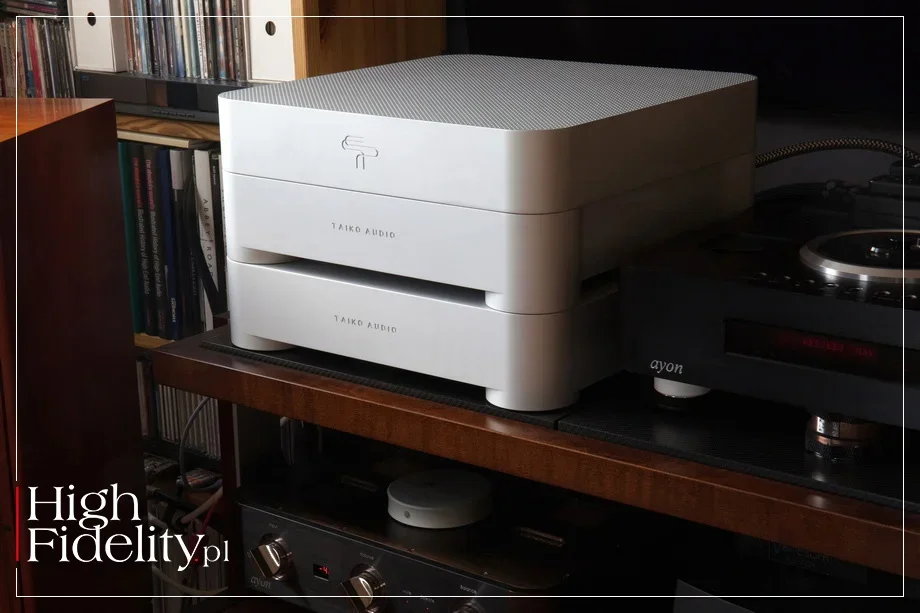
Functionality. Functionally, this massive device – weighing 85 kilograms (60 + 25) and measuring 480 x 480 x 304 mm (Olympus 190 mm + I/O 105 mm) – is simply an audio file server. That is, an audio file transport with internal storage. In reality, though, it is a complete file player, because a card with a D/A converter is included, even if it is an extra. But when we look at the description in the 89-page user manual, this simple picture breaks into a multitude of small pieces that have to be put back together from scratch.
First, the basics. The Olympus can store on its internal drive, or stream from the network, PCM signals up to 32 bits and 768 kHz and DSD up to DSD512. Internal storage from 4 to 60 (!) TB can be installed. The signal is fed to an optical SFP (Small Form-factor Pluggable) input; an adapter for an electrical Ethernet socket is also included. The signal leaves via either analogue or digital outputs. The company is also working on a volume control that will allow the device to be connected directly to a power amplifier.
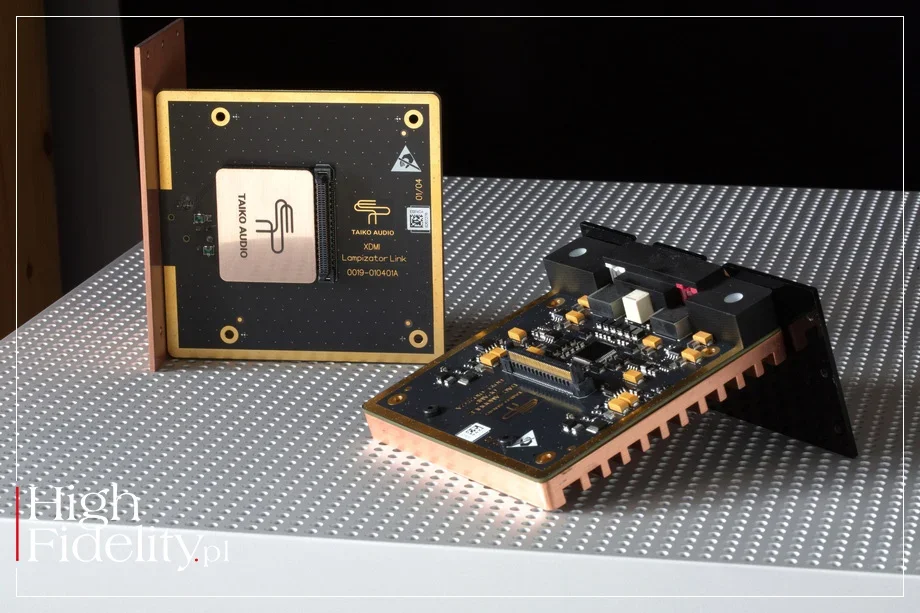
The Olympus is a modular device (the company uses both "Olympus" and "Olympus Server"), so it can work with different output cards – digital and analogue. It can also be expanded with an external unit, the Olympus I/O, an interface with a digital output. The Server ships from the factory with a digital card offering a USB output, a spare card with AES/EBU and RCA (S/PDIF) outputs, and a card with a digital-to-analogue converter. One of three links from D/A converter manufacturers can also be purchased: Aries Cerat (USB), MBS (optical) and LampizatOra. The last connects to the Olympus via a 4-pin XLR socket. In the server's manual, the section on the LampizatOra card mentions a cable option from another Polish company, KBL Sound.
The I/O module mentioned above can be fitted only with an AES/EBU output or a D/A converter. The company regards USB as a weak link in the system and recommends using the AES/EBU output. The module costs over 100,000 Polish złoty, so it is a really expensive add-on. And yet… I did not listen to these units separately. But experience teaches that professionals of this calibre are not trying to "push" anything on us. It is "only" an output module, connected to the main unit with two QSFP-DD (Quad Small Form Factor Pluggable Double-Density) cables, but one in which the board generating the digital signal has its own separate power supply.
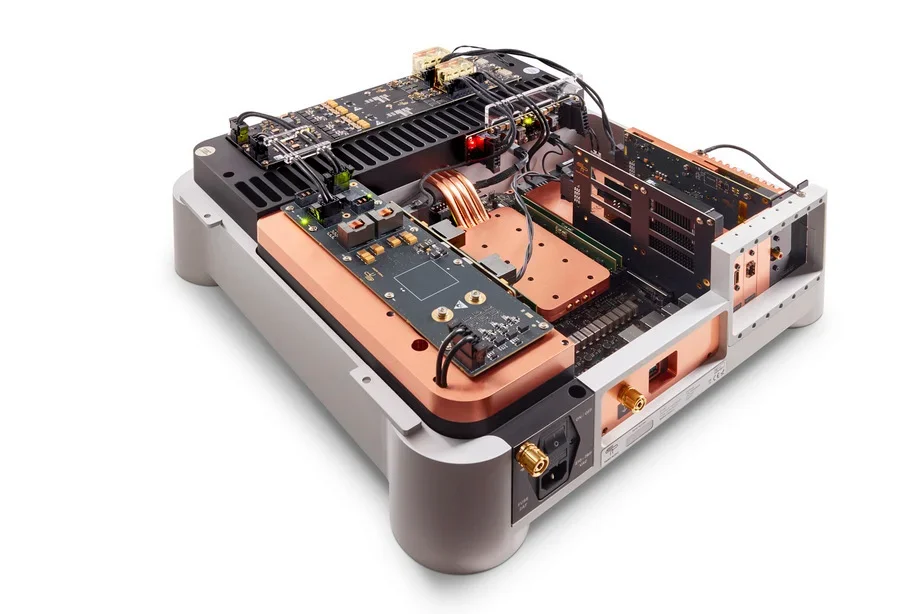
Technology. The device is really a specialised computer with a 24-core AMD processor (100.8 GHz) and 64 GB of memory. The processor runs software written specifically for Taiko Audio and stripped of almost all other functions. Marcin Ostapowicz of JPLAY spoke about this many years ago: the more tasks unrelated to sound reproduction a processor performs, the more noise it generates. And noise is the greatest enemy of digital (with analogue devices things look a little different).
The processor is cooled passively by a liquid coolant, which flows through copper tubes and is dissipated in large heatsinks. There is in fact a great deal of copper inside. The massive chassis is machined from a block of aluminium weighing 72 kg, and copper is used for heatsinks and shields in the individual modules.
One of Taiko Audio's most important developments for combating this kind of distortion is a system called XDMI. It is a rather complex design aimed at shortening the data path, and then the audio signal path, as much as possible. It is said to reduce latency by 250 to as much as 2,000 times compared with a classic USB link. XDMI works similarly to USB audio. XDMI replaces the USB driver, USB controller/card, USB cable and USB receiver. It is a modular system made up of 4 main parts:
- Software.
- A motherboard carrying the core of the system.
- Daughterboards providing the interface to a D/A converter or preamplifier.
- A "transparent" QSFP connection system allowing the motherboard and expansion card to be housed in an external enclosure.
Here is how one member of the Audiophilestyle forum explains it:
On the hardware side it is simply a PCIe card that connects to the CPU; in the Olympus server it plugs into a PCIe slot on the motherboard. Inside the Olympus I/O module it plugs into a very elaborate, technologically advanced PCIe extender. The other end of this PCIe extender connects to a PCIe slot in the computer – the Taiko Extreme or Olympus. On the hardware (physical) side you can think of it as similar to the PCIe cards made by JCAT, PinkFaun, SOTM and so on.
From this point things start to get complicated. The card is connected directly to the CPU via the computer's PCIe lanes. The music player (in this case Roon or XDMS) sends data directly to the card. In a very simplified way you can think of it as music software → CPU → XDMI. This requires a custom driver written by Taiko for Windows. So the card receives all the bits that make up the music being played in real time.
after: → AUDIOPHILESTYLE.com, accessed 14.01.2025.
The new Taiko Audio transport differs from its predecessor not only in processor, memory and mechanical design, but also in its power supply. The device is powered entirely by internal lithium batteries; the company describes their effect on the sound as "magical". The system is called BPS (Battery Power Supply) and is charged by three power supplies – one large, complex one and two smaller ones. The Server has two independent groups of power supplies and the I/O two more – which is one of the reasons why it can be a valuable addition to the system.
The power supply is one of the most important elements of the Olympus and is controlled by a computerised system – which also has its own name, BMS (Battery Management System). It can be set to manual charging, but it works best with charging set to "Auto", i.e. at night, between midnight and seven in the morning. Even then the device is powered only from the cells. All this is meant to reduce noise.
Even though we are talking about battery power, and thus independence from the mains, the manual contains recommendations on power cables. As we read, they affect the sound. This makes sense, and I have mentioned it many times in turntable reviews. A power cable acts like an antenna and introduces noise into the system. The better it is, the fewer such problems.
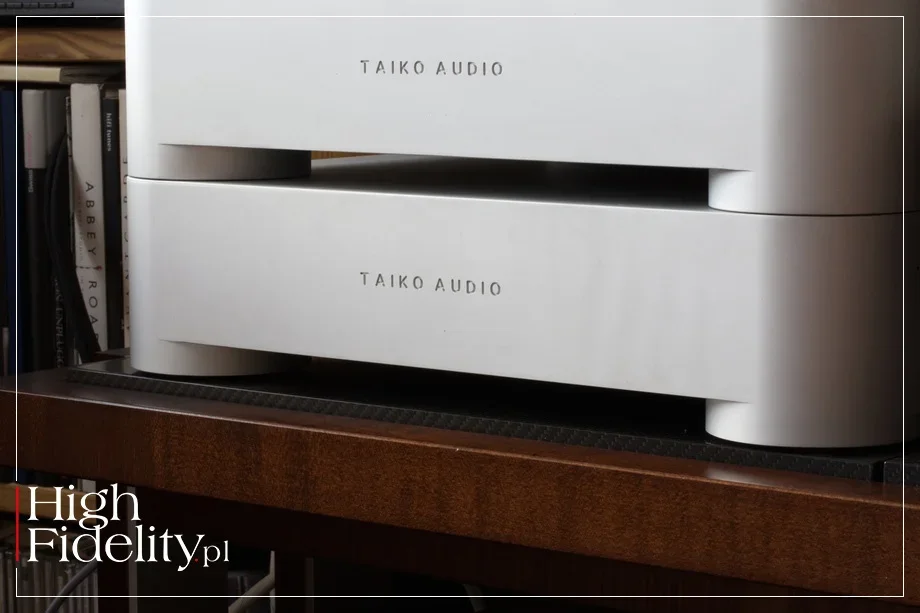
Both units stand on acrylic feet. The feet fit into a recess with an M6 (6 mm) thread, and the cut-out diameter is 90 mm. They can therefore easily be replaced with any other anti-vibration feet.
Playback is controlled via Roon – no other control software is compatible with the Olympus. The company is working on its own XDMI app, but it is not ready yet. You also need to download the Taiko BMS App separately, which is used to monitor the battery charge. The manufacturer assures that the device will play for ten hours after just an hour and a half of charging.
At the same time, it points out that the device sounds best when the batteries are well charged. Although the whole device could run on a single battery, with rapidly changing current demands – which is what we are dealing with – the source impedance and how it behaves over time matter a great deal. Which shows how incredibly transparent the Olympus is.
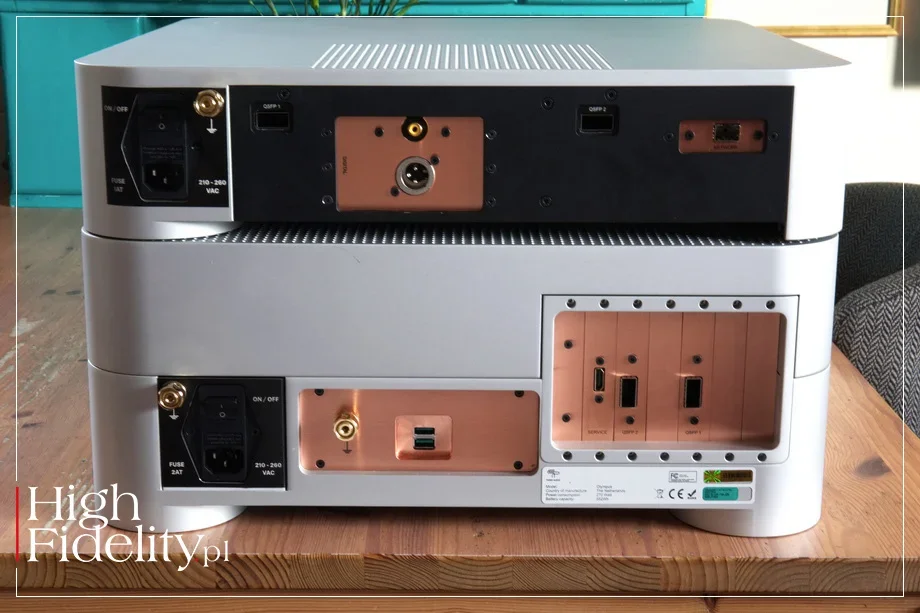
I have never before seen such an advanced audio device. Perhaps only the products of another company, Denmark's Aavik, could be put in the same league. They are, however, based on completely different techniques.
Listening
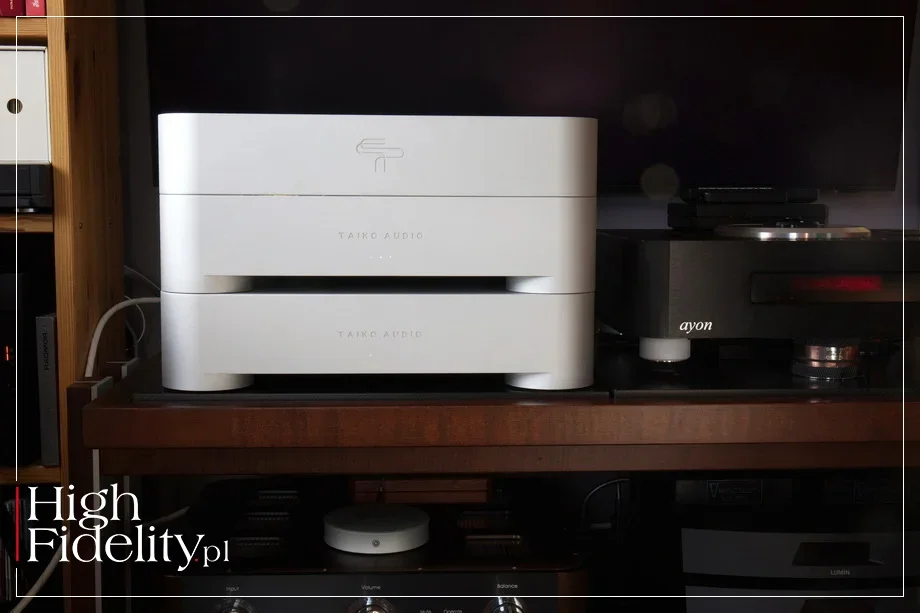
How we listened. The Taiko Audio Olympus file server stood on a Finite Elemente Pagode Edition Mk II rack. As there was no room to place them side by side, we stacked the Server and I/O modules on top of each other. Its sound was compared with the Ayon Audio CD-35 HF Edition SACD player. During the test I listened to files from a Lumin L2 NAS as well as from Tidal and Qobuz, using the Roon system installed in the server. The DAC in the Ayon was used as the converter – so the only variable was the transport: SACD or file. The signal was carried by a Stage III Concepts Chimæra AES/EBU cable.
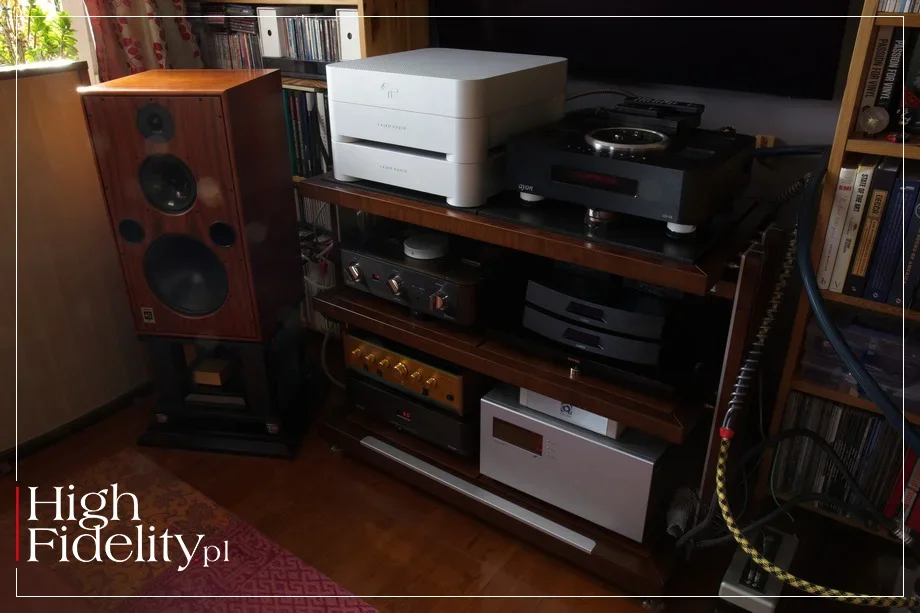
The player was connected to the router via my system consisting of a dual Silent Angel N16 LPS LAN switch, with its two modules in series, powered by a Tiglon TPL-2000A cable. The signal from the switch to both players was carried by a Quadrant Triple-C LAN cable with RLI-1GB Triple-C filters at both ends. The Server module was powered by a Harmonix X-DC350M2R Improved-Version cable, and the I/O by an Acrolink 8N-PC8100 Performante Nero Edizione (No. 1/15).
Recordings used in the test | a selection
- FRANK SINATRA, Nice’N’Easy, Qobuz 24/44.1
- JOHN COLTRANE, Blue Train, FLAC 24/192
- THE BEATLES, Abbey Road
- DOMINIC MILLER, Meeting Point, Tidal, FLAC 16/44.1
- SHELBY LYNNE, Just A Little Lovin’, The Look Of Love FLAC 16/44.1
- ARCHIE SHEPP & HORACE PARLAN, Trouble in Mind, FLAC 16/44.1
- THE MILLS BROTHERS, Lulu’s Back in Town (Original Recordings 1934-1935), Qobuz, FLAC 16/44.1
- COUNT BASIE & MILLS BROTHERS, The Board of Directors, Qobuz, FLAC 16/44.1 (1968/?)
- ICE CUBE, Man Down, Tidal, FLAC 16/44.1 (2024)
- LEONARD COHEN, You Want It Darker, Tidal, FLAC 24/44.1
I was curious how it would sound – oh, how curious I was! I had many opportunities to hear music through the Extreme at the shows in Munich, but show conditions are specific. You listen to a system in a room with music you do not know, in versions you do not know, with lots of people around you, with sounds coming through the wall and doors opening every moment. I am not complaining – that is not the point. I am only saying that although I had heard the Taiko Audio transport, it was as if I had never heard it before.
And indeed – all my ideas about this device, whether drawn from my earlier experience, from reading reviews and descriptions, or absorbed in conversations with other lovers of good sound, did not prepare me for what I heard at home. Not even close. Because, ladies and gentlemen, I had never heard anything like it.
When Frank Sinatra was finishing the last line of That Old Feeling, when, with his perfection, he held the "t" in the word "heart" that ends the phrase "For that old feeling, is still in my heart", when he takes a slight breath at the end of the word "burning" at 1:42, it sounded as if I were sitting in the control room watching the recording through the glass. In other words, it was incredibly natural and unmechanical. It was much the same straight afterwards with John Coltrane's Blue Train: when, in the intro, the snare comes in on the right channel at 0:36, tapping out a slow "tam-tam", I heard a real instrument, not its reproduction.
To be clear – I am exaggerating, and cruelly so. But this is the hyperbole that belongs to our industry, which says more than just: "Holy sh…!" When we say that something is "like live", we do not, absolutely do not, mean a sound "like live", but the emotions we experience. And these can be exactly as if we were sitting in front of a real performer. Sound is irreversibly changed by the recording, the medium and the playback – it always was, is and will be. But that is precisely the art: the art of arranging all the components of sound so that we feel it in a similar way to people sitting – for example – in Capitol Studio A with Sinatra and his orchestra.
I remember having a similar impression – the instant realisation that something exceptional was happening in my system – only a few times in my life. I remember it best from listening to the TechDAS Air Force One turntable. Yes, that is exactly how I remember it. As a kind of inner certainty that I was hearing something SPECTACULAR. I have used capital letters – in print they would be small caps – because the Olympus deserves them. Apart from the experience with the Japanese turntable and with my SACD player playing top Master CD-Rs, it was the most thrilling listening experience of my life.
That is why listening to music in the way I codified years ago and only supplemented later – with many repetitions and with reference to my own system and sources – proved unsatisfying with the Olympus. I simply preferred to surf Tidal and Qobuz, calling up tracks I often listen to and like. After a while I understood that this was a better way of grasping what this device is and what it is not. And of appreciating more fully what the designer has achieved with it.
I mentioned the turntable a moment ago for two reasons. I have already given one: the repeat of the excitement and surprise that machine brought when playing records I thought I knew inside out. The second reason was of a different nature and went deeper. I heard things then that defined my perception of reproduced sound. I have had something similar only once since, with the Ayon Audio CD-35 HF Edition SACD player, and to a large extent also with the Siltech Triple Crown cables and, recently, the Master Crown.
Both experiences were spectacular, but they differed significantly. Because, let me remind you, recording and reproducing sound belong to the realm of art. And art is not a depiction of reality, but of our ideas about it. They differed in the reference they related to, and therefore in the vision of the "worlds" they created. The TechDAS sounded like… a top turntable, the best that had played in my system up to that point. The Ayon player, on the other hand, sounded like a master tape. Both points of reference are analogue, yet they differ fundamentally.
The Taiko Audio Olympus with the Olympus I/O module sounded like the SACD player, only – better. It was exactly the same direction, the same vector along which the energy of the reproduction travelled. At the beginning I mentioned Sinatra when talking about details, because to me they were shockingly credible. As they were when Lee Morgan starts playing trumpet on the Coltrane album and you hear strong, really strong "pops", i.e. the diaphragm being overdriven.
Or when Dominic Miller plays guitar, first on New Dawn with Neil Stacey and then solo on Meeting Point. That was years ago, but the body remembers – it remembers the sound of this musician's guitars from an intimate concert in Bielsko-Biała, where I sat in the front row with Tomek, host of the Kraków Sonic Society meetings. As I say, this is about an impression, not real memories. But that impression of being present at a real performance was acute and all-encompassing.
The Dutch file transport plays in a way that is on the one hand very austere and on the other incredibly rich. Austere, because it embellishes nothing, does not warm or open up, does not deepen or brighten, does not emphasise or hide anything. And rich, because it delivers so much information in such an orderly way that we "enter" a given recording in a pleasant, good, natural way. There is no "wall" between us and the recording. At the same time, it is not an "easy" sound. I have often seen listeners choose the sound of a turntable even though they had previously heard the master tape from which the record was made. The Olympus delivers a sound similar to tape.
But not because no differences can be heard. They can, oh yes, they can! But they are not exclusionary differences. Taiko Audio plays in a way that brings into our circle of interest recordings we would not previously have touched with a barge pole. Or ones that define an entire era, and with the transport from the Netherlands it lets you bridge distant worlds. In my case that happened, for example, with The Mills Brothers compilation Lulu's Back in Town (Original Recordings 1934-1935) and the album they recorded with Count Basie in 1968, The Board of Directors.
The Olympus plays with exceptional resolution. And selectivity. And detail. Usually these three elements compete for our attention, and in the end resolution matters most, because it implies both precise imaging and clear detail. Here you could hear that they are, after all, different categories, each responsible for a slightly different slice of reality. Perhaps that is why we know immediately that this device plays with an extraordinarily wide bandwidth, without smoothing the attack at its extremes, without softening and without emphasising the attack phase.
And I have never heard bass like this in my system before. Except perhaps for the TechDAS already mentioned. My Ayon, playing CDs and SACDs, does not go that low. And yet I was listening through its D/A converter. Which shows how much potential still lies dormant in that design. But here and now, it was the stream from Tidal that sounded better. In fact, better than the same files played from the NAS. At times I had the impression that SHM-CDs and Master CD-Rs went a touch deeper into the sound, that they conveyed the inner softness of vocals, bass, guitars and so on even better. After a while I was no longer so sure, though the impression remained.
The Taiko also builds an extraordinarily expansive space. It is very precise in what it does; it is not a "romantic"-sounding device. When the backing vocals come in at the sides in You Want It Darker, the title track of Leonard Cohen's album of the same name, they are perfectly distanced in space, yet superbly connected to the reverb in which the other instruments live.
The vocal, in a completely different league of quality, sounded wonderful here. Not that it was better than usual – that is not it. But the emotional charge it carried "glued" it to the music, creating a seamless whole. It was perfect. When Cohen says "I'm ready, my Lord", we believe him. It is not just a song lyric, but the artist's personal confession from the bottom of his heart.
Summary
I, too, am ready, although my readiness concerns the "here and now". And I am ready to say that the Taiko Audio Olympus, in the version I tested, is one of the best audio products I have ever heard. So different from other excellent file players – I would mention the even more precise and even more energetic sound of the Aavik SD-880 (albeit without such wonderful naturalness) – that it is hard to recommend outright. The transport under test stands out in that everything it does, it does perfectly, and it can bring all of it together.
It plays with incredibly low, deep bass; the midrange is almost warm but in fact natural; and the treble is outstandingly resolving, precise and saturated. The dynamics seem limitless, although here it is above all about microdynamics. They remind me of what I know from analogue tapes. The space is huge, but precisely organised. It is formed by every element, even the tape hiss, which is placed on a different (physical) plane from the recording.
It used to be said that the company's Extreme model was "top"; now I say the "top" is the Olympus. So I am sure it can be pushed even further in the direction I remember from listening to the Air Force One turntable. But that is for another day. Today the Taiko Audio file transport is one of the best digital sources I know. And one of the best audio sources full stop. The GOLD FINGERPRINT award is a small tribute we can pay to the designer and his work.
This review was produced in accordance with the guidelines of the Association of International Audiophile Publications, an international association of the audio press that upholds ethical and professional standards in our industry; "High Fidelity" is a founding member.
Related products