 English





The Greek company Ypsilon Electronics was founded in 1995 in Athens by Demetris Baklavas and Fanis Lagadinos. Both former sound engineers with extensive experience in live concert sound, they set out to create audio components that could faithfully reproduce the sound of live music. Ypsilon products are known for simple but high-quality designs, often featuring custom transformers and hybrid circuits. This year the company therefore celebrates its 30th anniversary. We are testing its top power amplifiers, the Hyperion monoblocks.
One thing you cannot deny Ypsilon: scale. When we look at its range – the range of an amplifier manufacturer – we understand where a large part of the aluminium imported into Europe from Asia, Africa, Australia or South America ends up. And not just aluminium, but copper too, used for winding transformers.
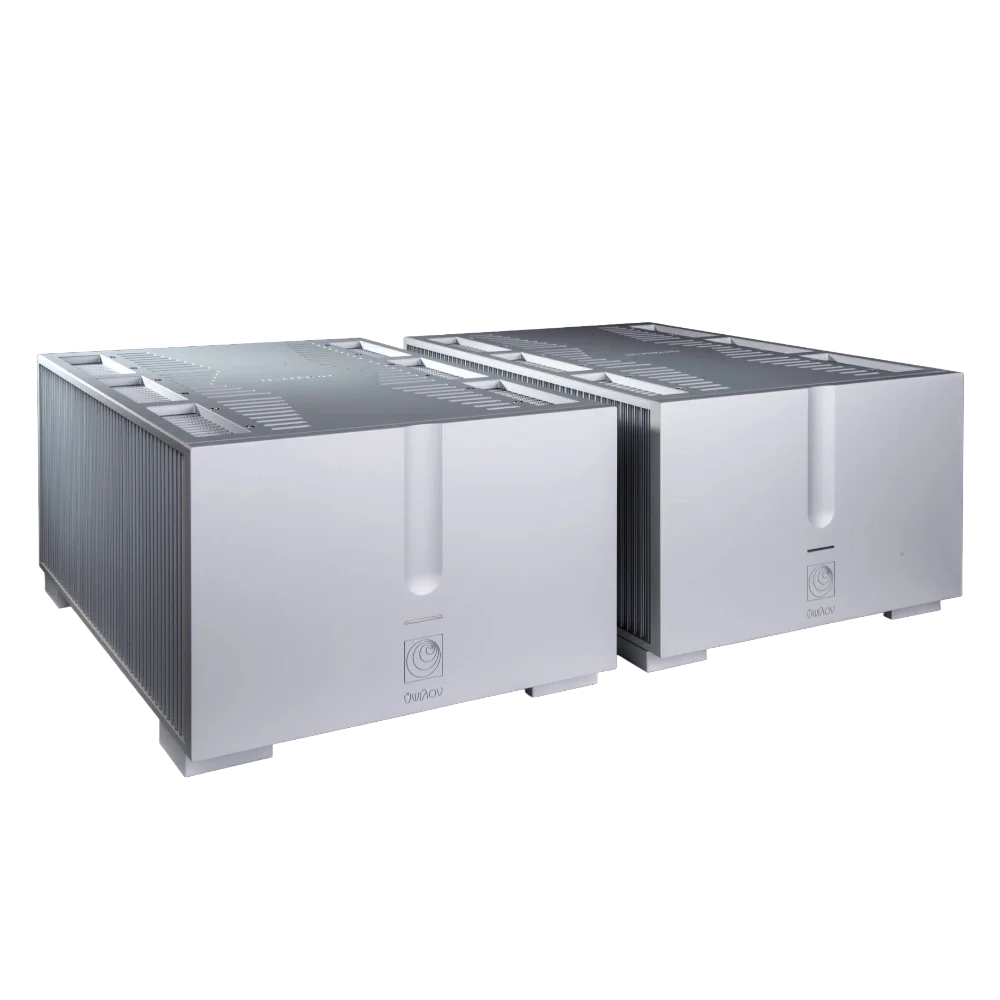
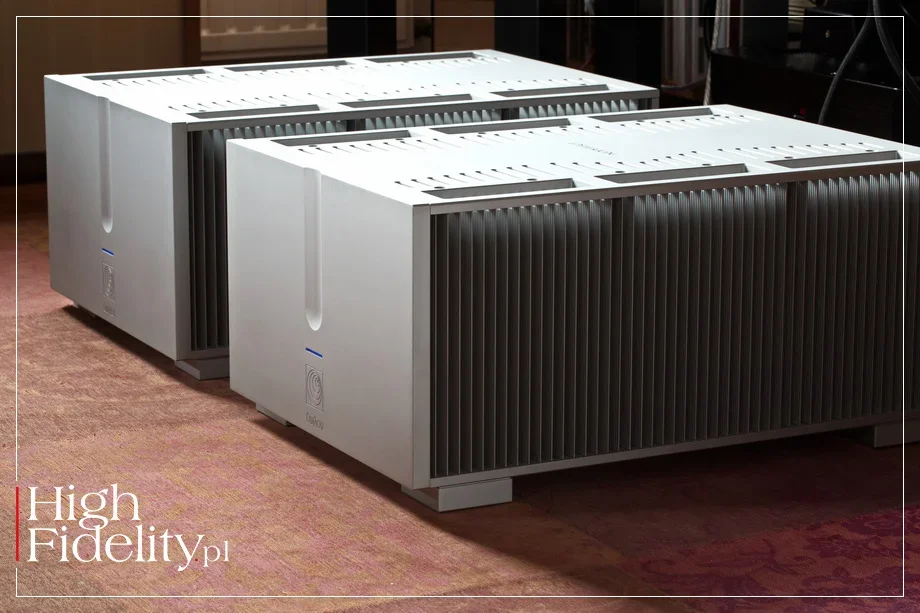
Take, for example, its top amplifier, the Hyperion monoblocks. First shown at High End 2016 in Munich, they weigh 95 kg each and measure 425 x 635 x 300 mm. They are huge. Their chassis are made of thick aluminium plates, and inside we find an enormous power transformer, two coupling transformers, two chokes and another power transformer. The amplifier under test delivers 100 W in class A and is built using hybrid technology – with a valve input stage and a transistor current section.
The stated power is not, however, the maximum. This company's amplifiers work much like Accuphase's class A designs. They are classic class AB amplifiers, but with a very high bias current, so a large part of their output falls within class A operation. Beyond that, the amplifier moves smoothly into class B. In this way the Hyperion delivers up to 370 watts into 8 Ω, 650 into 4 Ω and as much as 1150 W into 2 Ω.
The company writes about its amplifier:
Our long journey, during which we evaluated almost every available technology and component, both passive and active, in pursuit of pushing the boundaries of music reproduction, led us to develop and integrate transformers into amplification circuits. We realised that by using high-quality transformers as coupling elements, it is possible to overcome the limits of sound quality in an amplification stage, whether it is a solid-state or a valve stage.
Technology, YPSILONELECTRONICS.com, accessed 2.06.2025.
This brings us to the hybrid nature of the amplifier under test. In integrated designs it is encountered from time to time. Valves are used at the input for their linearity, and transistors (or integrated circuits) at the output to provide the required power. In power amplifiers such a solution is much rarer, which does not mean you never come across it. Think of the Tenor Audio 175S, the PrimaLuna Evo 300, or even the Rogue Audio DragoN with its class D output stage.
Ypsilon took a maximalist approach. The input section uses a 6H30 double triode of Soviet manufacture, which can also be found in the output stage of the Ayon Audio CD-35 player and in its D/A converters. Interestingly, in earlier designs such as the Aelius, the Greek designers used the C3g pentode, much rarer than the C3m that Ayon in turn uses in its Spheris Evo preamplifier. The input valve in the Hyperion has its own valve power supply with an EZ81 and a choke, and is coupled to the input via a transformer that provides a perfectly balanced input.
The two halves of the input valve are connected in parallel through separate windings to give each half an independent path for its bias current. It is worth adding that instead of the 6H30 you can use a 5687, for which a separate, empty socket is provided. With that valve you get a slightly different sound, but it also has higher distortion than the 6H30. A second coupling transformer is used between the stages. It allows the impedance to be lowered and a capacitor to be removed from the signal path. It has its problems, but without it the input stage would have to be much more complex. Its winding wire is made of silver.
The output stage is based on MOSFET field-effect transistors working in push-pull. The amplifier has no global negative feedback. In a word – a classic of audiophile high-end in contemporary form.
Listening
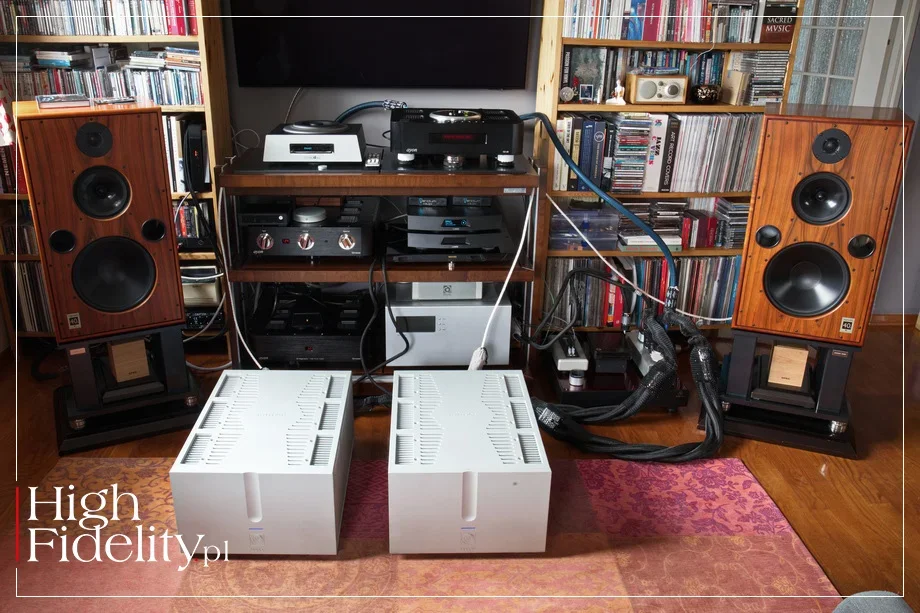
How we listened. The Ypsilon Hyperion power amplifiers were tested in the "High Fidelity" reference system. They were compared with the reference amplifier, the Soulution 710 solid-state power amp – in both cases the signal came from the Ayon Audio Spheris Evo line preamplifier. As sources I used the Ayon Audio CD-35 HF Edition SACD player and the Lumin T3 file player.
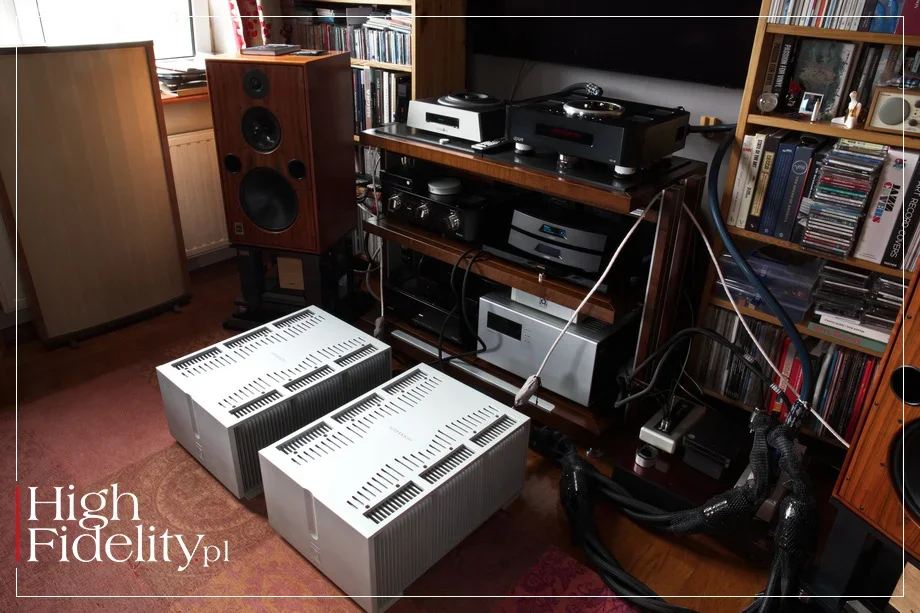
The signal between the preamplifier and the amplifiers was carried by a Siltech Single Crown RCA interconnect, and the signal to the speakers by Crystal Cable Da Vinci speaker cable. The amplifiers drove Harbeth M40.1 loudspeakers. During the test they stood on the floor in front of the system. Their power inlets are designed for cables with 20 A plugs, which I did not have. So during the test I listened to them with A.S.P. Reference Poseidon AC power cables.
Recordings used in the test | a selection
- AKIRA TANA TRIO, A New Picture I, ShinRec SRCD-8030, CD ⸜ 2024
- TERUO NAKAMURA, Unicorn, Three Blind Mice ˻TBM-18˺/Sony Music Labels MHCL-10178, SACD/CD ⸜ 1973
- HEART, Live in Seattle, Epic/Legacy E2H90287/SUHD 005500, 2 x Test Press SACD ⸜ 2003
- ASTRUD GILBERTO, The Shadow Of Your Smile, Verve/Verve Music Group 314 557 184-2, CD ⸜ 1965/2002
- TIËSTO, ODD MOB & GODBOYS, Won’t Be Possible, Atlantic Record Corporation/Tidal, FLAC 24/48, SP, 2025
- MARCONI UNION, The Fear of Never Landing, Just Music/Tidal, FLAC 24/44.1 ⸜ 2025
- THOM YORKE, Dialing In, Unsunstainabubble/Tidal, Dolby Atmos ⸜ 2025
Did I have any expectations when I sat down to listen to the Hyperions? – Of course I did! Some of the most expensive amplifiers I have ever had at home, huge, from a company with a good reputation – as if one could go into the listening with nothing in mind. Besides, I knew them from many demonstrations in Munich during the High End show. So my expectations were high. It turned out that reality was more interesting.
The Greek monoblocks sound so different from most of the high-end components I have had here that it was fairly easy to draw first conclusions. Only after a while did it turn out that what seemed simple was not, and that what seemed clear was becoming ever more complex and therefore hard to put neatly into words. What I began the test with, and what I ended it with, could nonetheless be summed up as follows: these are extraordinarily high-resolution devices that differentiate musical material in an outstanding way.
Their bandwidth is very wide, and its extremes have the same energy as the midrange. The latter sets the tone of the whole, but every element bubbles with events; everything here has its weight and nothing is covered up or forgotten. The point is that the Ypsilons deliver sound directly, without the hesitation we get with most other products of this kind. That is, without the subtle "film" between the sound and us that is present even in the best amplifiers, such as the Kondo Ongaku or my Soulution. Sometimes, as in the latter's case, it is a film that allows nuances we had not heard before to be drawn out of the sound, while presenting everything with refinement and a kind of reverence. But – still…
The Hyperions play music in a far more direct way than any amplifier I have had here. And yet they never irritate. It is a way of playing that reminds me of my visit to the studio of Polish mastering engineer Jacek Gawłowski, watching the mix and master of the song Pielgrzym by the Polish band T.Love. There was both an insight into the depths of the mix and a sense of the whole, which perhaps even dominated everything. It was as if I were sitting in front of the control-room glass while, in the studio beyond it, a band warmed up before the actual take.
Listening to recordings from the Akira Tana Trio's A New Picture I, recorded live in one take, without editing, using just two microphones, I could not fail to appreciate how phenomenally the amplifiers under test convey energy and how precisely they render the leading edge. That is why the sound seems so fast, the attack immediate. Not through artificially emphasising the rise phase, but through rendering it ultra-precisely. Ultra-precisely, that is, in full, in density, in a cloud of information about what is happening there.
Thanks to this, the drawing of sound sources is exceptionally clear. We get precisely rendered bodies, and the various subtleties of playing are conveyed superbly. This is not mindless thrashing but multi-dimensional, interesting playing. Yet not overly sharp. Perhaps I should have started with this, but it is never too late: despite absolutely perfect transparency and speed, the amplifiers under test are not bright. The first bars of the album I just mentioned left a sweet aftertaste on my tongue; they were downright warm. That impression passed after a while, but not entirely.
Because the Hyperions are not devices that can be "caught out" on this or that; they require long listening to truly understand what they are and what they offer. What's that – I wrote a moment ago that I knew straight away what they were about? – Well… Not entirely. Even I was surprised that after a while I began to find things in this sound that had escaped me at first. It was like peeling – to borrow from Shrek – an onion. You think you know what you are looking at, but you have no idea how much lies underneath.
And here there is something that could be called reliability and credibility. In short – high fidelity. Teruo Nakamura takes no prisoners on Unicorn, released by Three Blind Mice. This is fusion with everything we love it for: experiments, classic jazz, flights of fancy and melody. The Greek amplifiers showed it in all its glory – even better than my Soulution 710. Denser and clearer at the same time, faster and warmer at the same moment, with a more strongly drawn bass – but a better-articulated bass, and not overdone at all.
It was something like a direct transmission into my body. Not even my head, because there was a great deal of emotion in it, not just "understanding". I do not know if you remember the song Transmission Into Your Heart by the Polish band Houk? – That is exactly how I felt when I heard the bass on that album, when the drummer hit the snare, or when the piano appeared further back in the mix. But it was by no means a mechanical transfer of sounds from the speakers to me. And that is precisely what I found most interesting about these amplifiers.
After the stunning success of Girl From Ipanema, Astrud Gilberto had the door open to a career in the USA – that is, worldwide. She made use of it, releasing a series of albums in the following years. One of them was The Shadow of Your Smile, recorded in 1964 and released by Verve in 1965. I mention it because it is radically different from both of the albums mentioned earlier, and also because the Hyperions communicated that difference already in the hiss at the start of the title track.
In the sense that I got, and got immediately, a large perspective, large phantom images, but above all delicacy. What I said earlier about the direct transmission of energy – as if the room contained not air but a copper conductor – was evident here too. But this time that directness "served" a different musical sensibility. Whereas before the dynamics were explosive and the drawing of sources comparable to hearing live music, now you could hear that this was a studio recording, produced in a particular way and meant to convey different emotions. Like melancholy, like sadness, like – after all – the hot air of the Brazilian coast.
The amplifiers under test played the album with great sensitivity. I remember that this is how SET valve amplifiers play with the Harbeths in my system, be it the Ongaku mentioned earlier, a Phasemation or an Octave Jubilee 300B. Yes, it is hard to believe, but the Ypsilons presented Gilberto's voice – so fleeting, almost esoteric, girlish even, innocent yet full of passion – in the way it deserves. As a result I did not focus on its shortcomings but on the melody, on the atmosphere. The same could be said of the amplifiers themselves. As if their size and their reserves of power, dynamics and resolution were so great that they could step back behind the music without feeling that something was passing them by, that nobody "sees" them.
Exactly – these are devices that do not flaunt their presence. Even though they play in such an open way. Even my Soulution 710 does that to some extent, although it is very restrained in this respect. The monoblocks play in a more open way with wider bandwidth, but not in a more aggressive way because of it. Thanks to perfect internal coherence it is an almost calm, beautiful sound. In other words – not attacking, rather assisting. That assistance consists in delivering the sound in its fullness and dynamic uniqueness, as at a live event, yet without exaggeration, without any need to prove "I can do it".
And on top of that there is outstanding spaciousness and holography. When I began listening, I had to check whether I had really connected the speakers in phase. The presentation was exceptionally expansive and free of limitations. As it turned out – no, everything was fine, and the impression of power came from the way the Hyperions convey even the smallest details within a full cloud of sound, which makes the presentation so expansive. Because that is what space is about: the resolution of the lowest-level elements. This was evident even with recordings such as Heart's Live in Seattle, released in 2003, documenting their last concert in Seattle on the "Summer of Love Tour" in summer 2002.
My version is special – a Test Press SACD – but even it cannot hide that this is a typical multitrack recording without much depth. Even so, this time it was fun, dynamic and gripping. The bass boomed a little and was not very deep, but that did not bother me. More important was the midrange, with Nancy Wilson's vocal and the guitars, where most of the action was. Whereas with jazz recordings the Hyperions played in a maximally open way, because that was the nature of the material, here they played it in a subdued manner, without too much detail – again, because that is how this material is.
This is a chameleon amplifier. That is, one that adapts to the music, not the other way round. You feel no pressure in how it works. If we have classic jazz, it goes in that direction. The sound will then be transparent, high-resolution and ultra-dynamic, with perfectly rendered sources. But if we play contemporary club music with it – let's say Tiësto, Odd Mob and Godboys with Won't Be Possible – we instantly enter the vibe of people in a closed space where the bass is compressed (squeezed) in a way we only experience at big open-air concerts.
The hyper-spatial music of Crystaline by the English band Marconi Union, on the other hand, sent me soaring in a single moment – literally. As if it were no problem at all for these amplifiers to dive into the depths of the bass and, the next second, take off into a soaring glide, beautiful and smooth, yet full of nuances and details that make it not a dull drone on one note, but something more – what good ambient can be.
Summary
The Ypsilon Hyperion amplifiers are the best devices of this type I have had at home, except perhaps for the Kondo Ongaku integrated amplifier and the Kondo Gakuoh II, which showed something even "more". Though not in every respect. I did not want to make a show of it earlier, so as not to impose my perspective on you, but this is how – in my view – the best valve amplifiers of the SET type play. Here, though, we have even greater ease, thanks to the available power. And the bass is better controlled and defined, while also more saturated.
The power I am talking about is not brute force, but is intelligently distributed and used to emphasise aspects of the reproduced sound rather than of the amplifier's own sound. That is there somewhere, but it is hidden very deep so as not to dominate. So I often had the impression of sitting in a mastering studio – a good studio, I should add. It was direct, dynamic and energetic playing. And yet outstandingly musical.
This is not just a machine, but something like a "ghost in the machine". The closest to it would be the 711 Mk II amplifier from the Swiss company FM Acoustics. But even so, the Greeks show something a notch higher. An outstanding device, one of the best I have dealt with in my life. No candy-sweet sound, and yet sweet; high-resolution, yet never "piercing". Simply a REFERENCE. From us: GOLD FINGERPRINT.
Design
Ypsilon's Hyperion is a mono power amplifier. Such devices are called monoblocks, and two are needed for stereo listening. The device is very large and heavy: 425 x 635 x 300 mm and 95 kg each.
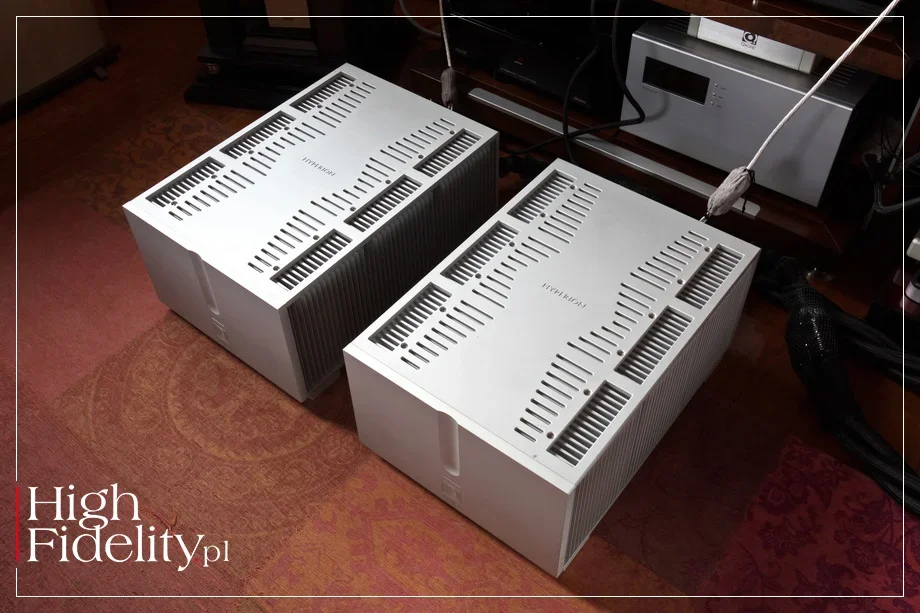
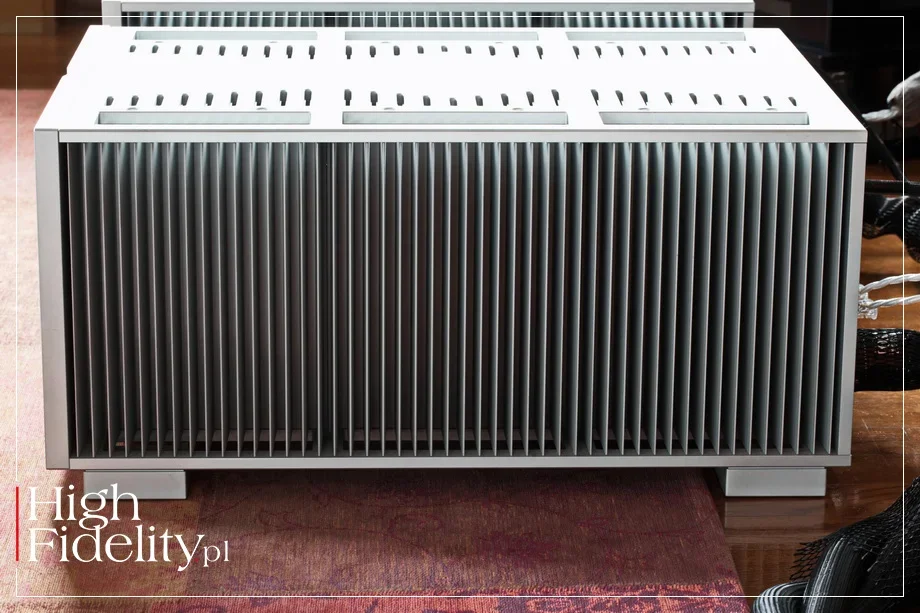
Its chassis is made of aluminium plates reinforced at the joints with aluminium beams. The front panel is thicker, and very large heatsinks with corrugated fins are mounted on the sides; the corrugation increases the effective cooling surface for the same size. To avoid injuries from sharp edges, the chassis has a slightly larger outline that covers the edges.
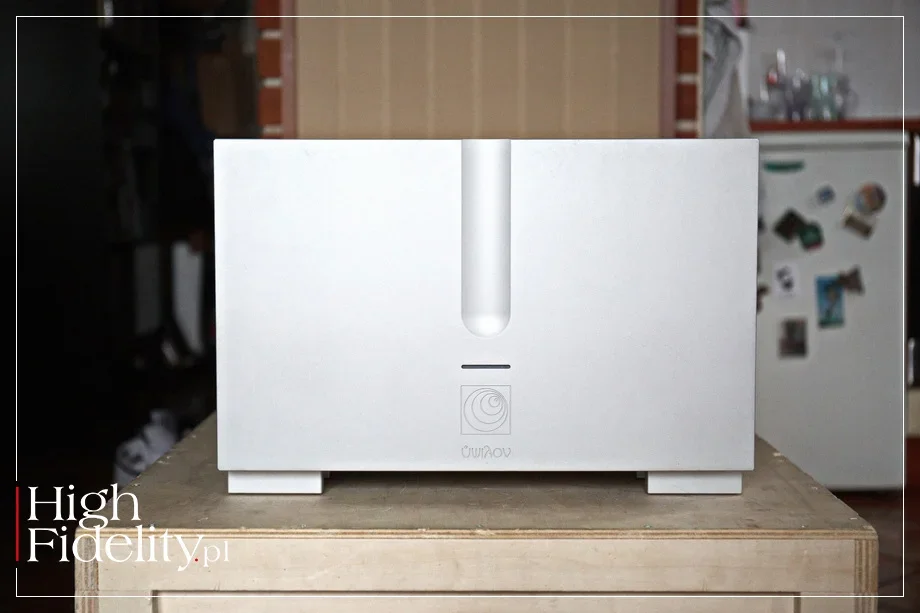
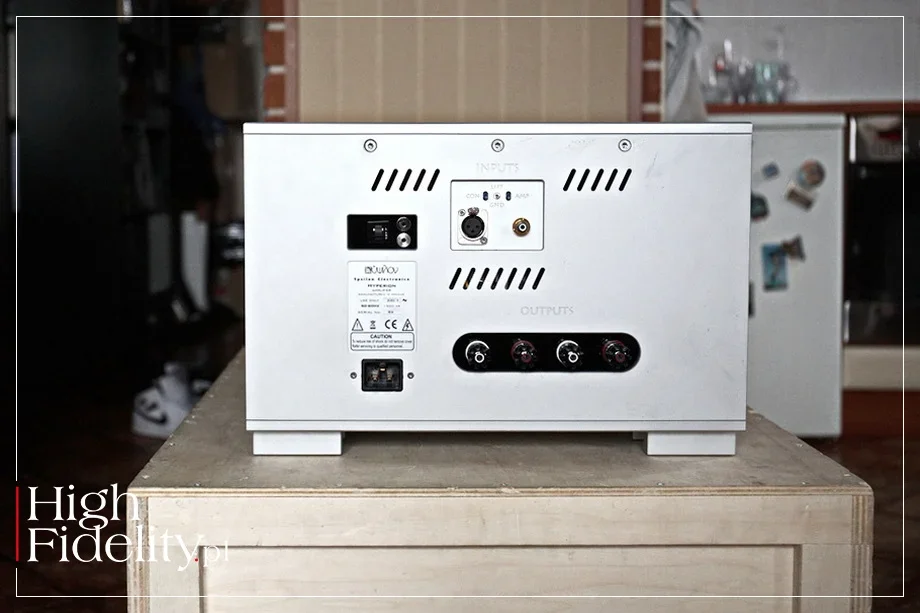
At the front there is only a long blue light strip and the logo. More happens at the back. There we find RCA and XLR inputs, as well as a switch that disconnects signal ground from the chassis. Both inputs are equivalent, since the input circuit is not balanced. There are also two pairs of very good speaker terminals, making bi-wiring easier. The gold-plated RCA input (WBT-0210) and the speaker terminals come from WBT (WBT-0703) and belong to the Nexten series, in which the amount of metal has been minimised. There are also two triggers at the back for switching the unit on and off remotely, for example from the preamplifier.
The inside is as simple as it is impressive. In the centre is a power supply built around a massive transformer with four secondary windings. Each rail (plus and minus) has its own supply. The transformer is of classic construction with EI laminations, even though we have grown used to manufacturers advertising their amplifiers by pointing out that they use toroidal transformers. Ypsilon clearly has a different idea about sound.
The transformer works with a bank of 24 Mundorf capacitors with a total capacitance of 112,800 µF. They are soldered to a board bolted above a choke that is part of the output transistors' power supply. These are MOSFET (metal-oxide-semiconductor field-effect transistor) devices: IRFP240 and IRFP9240 from Vishay. Each monoblock uses six pairs of transistors. They are driven by bipolar transistors.
As in the Aelius, the Hyperion's output is "floating" – neither the positive nor the negative terminal is grounded. The amplifier is protected by a circuit based on thyristors. So there is no relay. If there is a short circuit at the output, the load drops below 1 Ω, or the circuit detects DC at the input, the amplifier switches off automatically. Once the problem is resolved, switching the amplifier back on restores the output signal.
A separate module is dedicated to the valve input – the Hyperion is, after all, a hybrid amplifier. Here a Soviet 6H30 valve works with its own power supply. That supply has a shielded C-core transformer with silver windings, a choke and an EZ81 rectifier valve, i.e. a full-wave rectifier. In the review unit it is a Mullard NOS valve. A curiosity – next to the amplifying valve there is an empty socket for another valve type, should we want to change something in the amplifier.
The internal wiring uses specially drawn, Teflon-insulated silver wire, custom-made for Ypsilon.
Specifications (according to the manufacturer)
- Output power: 370 W RMS/8 Ω, 650 W RMS/4 Ω, 1150 W RMS/2 Ω
- Frequency response: 6 Hz – 80 kHz (−3 dB)
- Input impedance (RCA, XLR): 22 kΩ
- THD (1 kHz/8 Ω): 0.7%/100 W, 1.2%/300 W
- Gain: x20 (26 dB)
- Power consumption: 400 W (idle)
- Valves: 6H30 Pi or 5687 (input), 6CA4/EZ81 (rectifier)
- Dimensions (W x D x H): 425 x 635 x 300 mm
- Weight: 95 kg
Related products