
 English





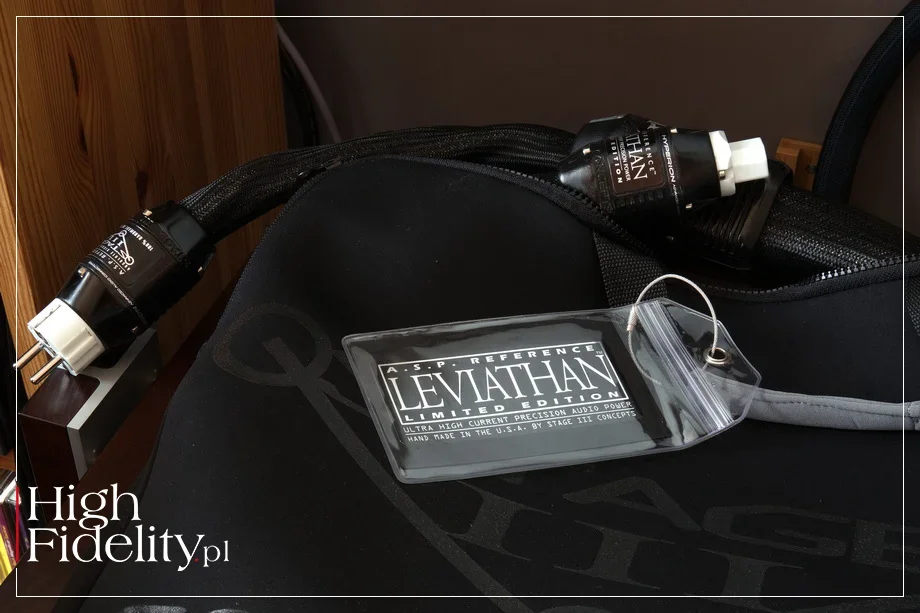
Stage III Concepts A.S.P. REFERENCE LEVIATHAN LIMITED EDITION
22.06.2025
- The authorWojciech Pacuła
- SourceHigh Fidelity
Stage III Concepts is an American company based in Brooklyn (New York) that specialises in audio cables. It was founded in 1996 by Luis de la Fuente, who is both its owner and its designer. Stage III Concepts made its name with cables using a vacuum as the dielectric, and later with rarely used conductor materials. It also makes its own plugs. Its cables are heavy and very massive. We are testing its A.S.P. Reference Leviathan Limited Edition AC power cable.
If I thought that the Proteus AC power cable, designed and built by Stage III Concepts, was the thickest and heaviest cable of its kind I had ever seen, I was not wrong. But only because I had not yet held the Leviathan in my hands. Or perhaps both are simply monstrous, like mythical sea creatures? That may well be so…
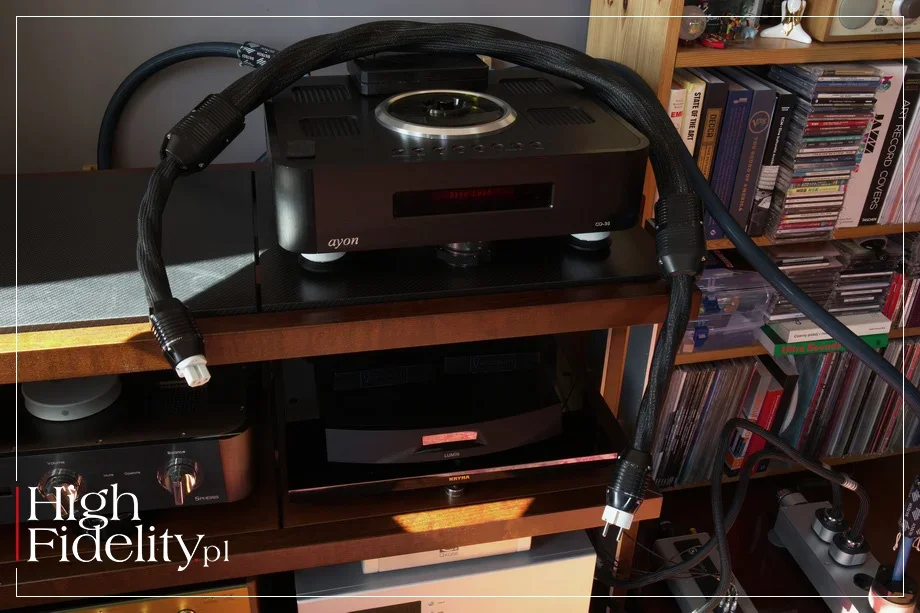
This cable has been in production for many years – I remember its review in "Positive Feedback" from 2015. In that time it underwent only minor modifications. Until 2021, when the Stage III Concepts Company celebrated its 25th anniversary. To mark the occasion, it prepared a limited edition of its complete cabling – interconnects, speaker cables and AC power cables – adding "Limited Edition" to their names.
According to the company's materials, this was a "cost-no-object" project in which Luis de la Fuente, founder and designer, could "fully develop all his key concepts and solutions". We are testing one of those cables.
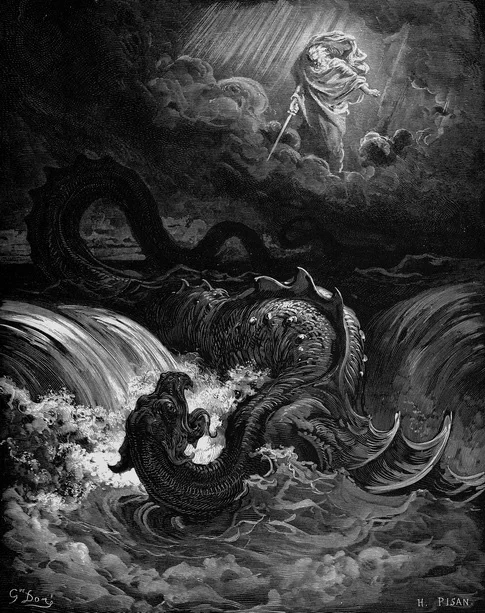
Leviathan
The Destruction of Leviathan, engraving by Gustave Doré, 1865; Wikipedia, public domain.
1. Leviathan – "a biblical sea monster symbolising the evil that God will destroy at the end of time"
2. Leviathan – "in the Bible: a sea monster of strange shape, with which folk belief associated various legends, most often concerning the end of the world (…) Lat. Leviathan, Heb. Liwjātān = lit. a creature with a coiled body, crocodile, whale" ("Słownik języka polskiego PAN", ed. W. Doroszewski)
"Słownik języka polskiego PWN" → sjp.PWN.pl, accessed 20.09.2024. (Definitions translated from the Polish dictionary.)
From the very beginning, the hallmark of this company's early designs was the use of a vacuum as the dielectric. The second important distinguishing feature became conductors in the form of flat ribbons made of a silver-palladium alloy. But just as important was the damping of internal vibrations, thanks to carefully chosen materials and a topology developed by Luis de la Fuente, owner and designer of Stage III Concepts.
In the company hierarchy, the Leviathan is second from the top and one of the manufacturer's seven AC power cables. Above it sits only the Poseidon, ruler of all the creatures that inhabit the seas :) Today, vacuum is found only in the company's top products. In the Leviathan under test it has given way to air, but all the other solutions are still "in play". While we are at it, A.S.P. in the name stands for Absolute Signal Purity – a motto meant to express the manufacturer's pursuit of complete neutrality in its cables.
Leviathan
On its website, the manufacturer points out that it was the first audio cable company to use "floating" ribbon conductors for power applications, i.e. conductors suspended in a vacuum or in air. This development was used in the Kraken power cable – the Leviathan is simply three (!) Krakens in a single braid.
Leviathan – cross-section
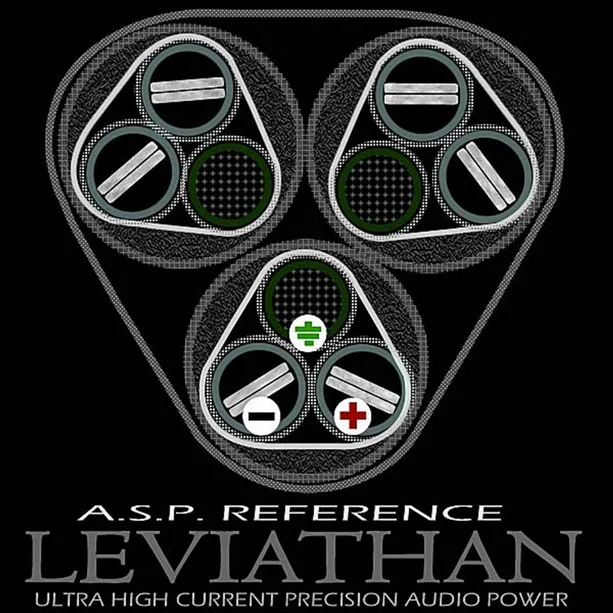
The Leviathan is an exceptionally complex design mechanically:
- shielded silver protective earth conductor,
- H.D.A. foil shield,
- granular vibration-damping and shielding layer,
- double silver-palladium ribbon conductors,
- FEP Teflon tubes,
- silver-plated copper braid,
- soft polymer jacket,
- Aspis outer shield,
- outer nylon braid.
As the drawing above shows, the conductor arrangement of this cable consists of three completely independent multi-core cables. Thanks to their large total cross-section, it can carry currents of up to 80 amperes. So all the big "furnaces" are welcome. But not only them. In my experience, signal sources also benefit from this kind of capability. Their continuous current draw is small, but momentary, really very fast transients are an everyday occurrence, and they can have a large amplitude.
The manufacturer writes about the Leviathan:
Extreme mechanical damping combined with impenetrable layers of patented shielding and the conductor geometry completely eliminates any microphonic effects induced by vibration or airborne electromagnetic interference.
Among its many sonic attributes (especially with amplifiers), you can expect a superbly low noise floor, smoothness and a relaxed authority that eliminates any compression and "tension" audible with most other power cables of conventional design.
No high-end amplifier on our planet, regardless of size or power requirements, will be held back or even challenged by the A.S.P. Leviathan.
Leviathan. Statement Audio Power, → AUDIOIMPORTS.com, accessed 19.09.2024.
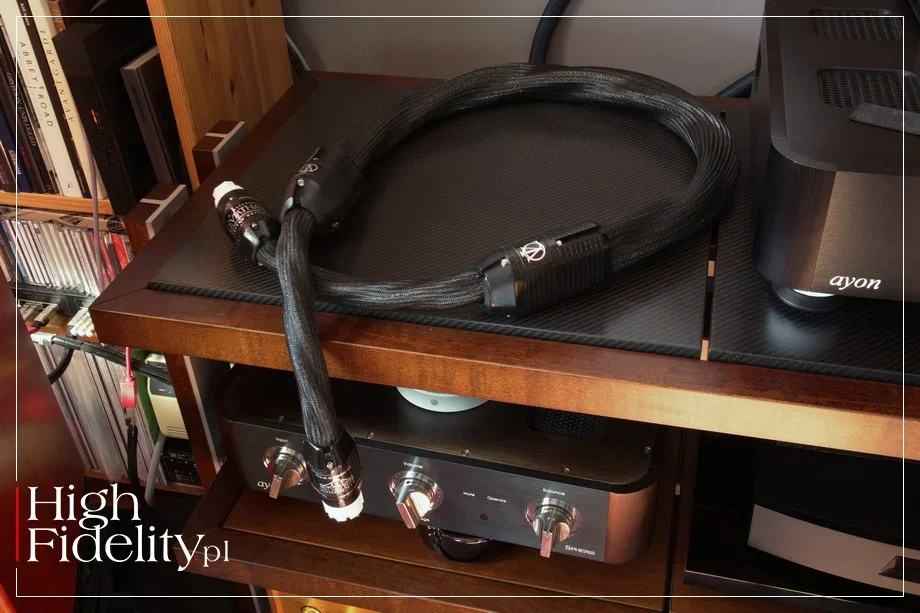
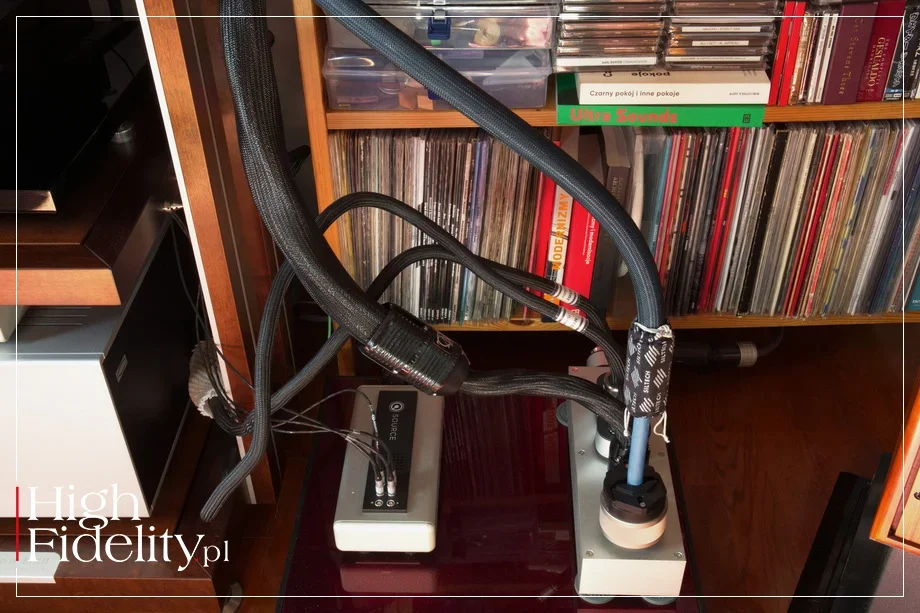
The cable in question is very thick and stiff. To avoid ripping out the power inlet, you need either special cable risers, or the powered component has to stand on the floor or on a large platform. The cable consists of three sections, the two outer ones slightly thinner and terminated with plugs. The middle one is thicker and joins the other two through in-house-made "sleeves", which serve not only an aesthetic but also a mechanical, vibration-damping role.
The manufacturer states that the Leviathan, like its other cables, is made 100% from components produced specifically for Stage III Concepts – so it contains no parts mass-produced for other companies – and that it is assembled by hand by the owner. Important in its design, we read, was "extreme mechanical damping" combined with "impenetrable layers of patented shielding and the conductor geometry". These solutions are meant to completely eliminate any "vibration-induced microphonics" or "electromagnetic interference".
When we look at the Leviathan's cross-section, we see three cables in one, twisted around each other. Each of them in turn consists of three runs, also twisted. The "positive" and "negative" runs are each made of two silver ribbons. The manufacturer calls them AeroStrandUltra and adds that they have undergone cryogenic treatment and are drawn from a silver-palladium alloy in a slow process. The third run, the so-called "earth", consists of thick silver wires. As the designer mentioned earlier, shielding is crucial for him, which is why every run individually, as well as each group of three, has a silver-plated copper shield.
The ribbon conductors sit in an air dielectric inside FEP tubes, i.e. tubes made of fluorinated ethylene propylene, a fluoropolymer. In addition, a layer of silica, ceramic and ferrite has been applied to them to damp vibrations and provide extra shielding. These tubes rest in a thick vibration-damping material and are placed inside a silver-plated copper shield.
The company's cables, not only the power cables, are terminated with plugs the manufacturer calls Hyperion, whose contacts are made of a copper-silver alloy coated with a layer of palladium. The contacts are mounted in a ceramic module onto which a 3D-printed body reinforced with carbon-fibre braid is screwed from the outside. They are among the largest plugs of this kind I have ever seen. According to the manufacturer, however, they are an important element of the cables' mechanical construction. All metal parts, including conductors and plugs, undergo thermal – cryogenic – treatment.
Listening
How we listened. During the listening sessions, the Stage III Concepts Leviathan AC power cable powered the Ayon Audio CD-35 HF Edition player (No. 1/50) and was compared with my reference, the Siltech Triple Crown power cable. The test was an A/B/A comparison, with A and B known, using short two-minute samples from each disc.
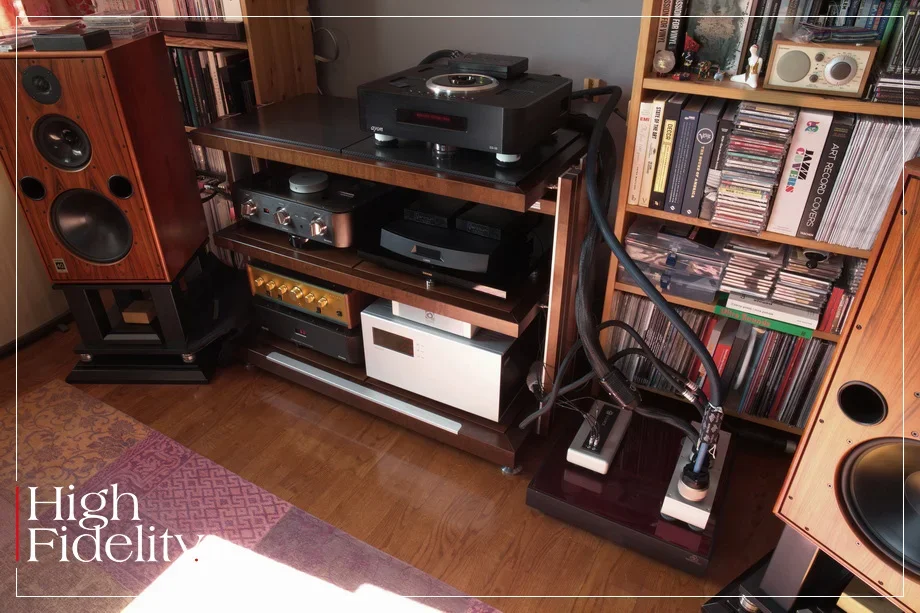
Both cables were plugged into an Acoustic Revive RPT-4EU Absolute power strip, which in turn was fed by a 2.5-metre Acrolink Mexcel 7N-PC9500 power cable. The Acrolink was connected to a Furutech NCF wall socket, served by a dedicated power line with its own HPA circuit breaker. This line is made from a 6-metre run of Oyaide Tunami Nigo cable.
Recordings used in the test | a selection
- DOMINIC MILLER & NEIL STACEY, New Dawn, Naim naimcd066, CD (2002).
- LARS DANIELSSON & LESZEK MOŻDŻER, Pasodoble, ACT Music ACT 9458-2, CD.
- MARK KNOPFLER, One Take Radio Sessions (The Trawlerman’s Song EP), Mercury 9870986, Studio Digital Clone CD-R (2005).
- FRANK SINATRA, Come Swing With Me!, Capitol Records CDP 7 94520 2, CD (1961/1991).
- MILTON NASCIMENTO & ESPERANZA SPALDING, Milton + Esperanza, Concord Records UCCO-1243, SHM-CD (2024).
- KATE BUSH, The Dreaming, EMI Records 7 46361 2, CD (1982) in: This Woman’s Work: Anthology 1978 – 1990, EMI Records CDKBBX, 8 x CD (1990).
- PORTISHEAD, Dummy, Go! Disc Limited/Universal Music Company [Japan], UICY-20164, SHM-CD (1994/2011).
Comparing any AC power cable with the Siltech, which is part of the "High Fidelity" reference system, usually goes very much the same way. My first thought after the switch is how much I have lost. Only the second turns to the differences and to what makes the cable under test stand out after all. With the Stage III Concepts Proteus, that feeling was much less acute than usual. With the Leviathan, in turn, there was no question of a clear difference in class.
It was a slightly different sound, with the accents falling in slightly different places – these are, after all, different techniques, conductors, topologies and so on. And yet you could hear that the thinking about sound, the understanding of it, was similar in both cases, as if people who really listen – and I mean the designers and their R&D departments – were heading in a similar direction. Sometimes that is just how it is.
And it is about depth, silence and darkness. With the Leviathan we get all three. It is a cable that plays in a very saturated way, also presenting a large volume of sound. The Siltech goes even further in this, even more strongly, but these really are subtle changes. The American cable, on the other hand, more clearly celebrates small details, such as the smoothness of the nylon guitar strings on Dominic Miller and Neil Stacey's New Dawn, and builds a smooth timbre more strongly.
It is also a cable that presents sound across the full spectrum. At the top it seems a little sweetened, creamy, but perhaps that is just an impression. Because when, at 2:16 into track 4, La Belle, a percussion instrument – struck by hand, I think – comes in, with the cable under test it is distinct, strong and full. It has a long decay but also excellent definition. And the bass went very low here. It seems even lower than with the Siltech, though with a slightly emphasised fill.
On that disc the bass comes mainly from a keyboard instrument, a synthesiser, so it is hard to talk about "naturalness". But if someone pinned me down, I would say the Leviathan presents the bass in an unrestrained way. Yes, that is probably the best description. It is superbly controlled – the Harbeths cut the note off instantly when it was played that way, but also delivered a long sustain when the musician held the key a little longer.
The Leviathan is also very high-resolution and selective. Its tonal balance leans slightly towards the bass and a strong lower midrange. But there is plenty of treble too, only it is silky treble, not "steely". And its greatest strength, which flows directly from the qualities I have just described, is its ability to play literally every kind of music the way music lovers dream of. That is, on the one hand without the "stress" that something will sound bad, and on the other with the certainty that we will get the full sound, all the details and nuances we care about.
Related products